
1 Why posters?

Forestier, Henry-Claudius. XIII. Schweizerische Kunstausstellung Zürich. 1917.Public domain through Wikicommons.
In an age of fast information and never-ending digital feeds, the importance of posters might seem slightly unclear. However, for a long time, posters were the best way to share information.
These days we have the internet, smartphones, and many different gadgets that can keep us updated about what is happening around us. However, and if you have ever stumbled upon posters lining the walls of a subway station, pretend that they are the only way to know about a lot of things: what new products are out there, what governmental services are being offered, or what exciting events are happening near you. There is no internet, no smartphones, and these posters are not only informative, but colorful, and vibrant; they catch your eye and turning your attention to them is enjoyable.

Picture of the Locarno Film Festival poster.
Kumar, Ank. Locarno Film Festival.2019. CC4 through Wikicommons.
Posters, like any other form of artistic expression, have gone through a fair share of changes and evolution in their design. Likewise, there have been varied materials, techniques, styles, and ways to make posters. Not only are there variations from designer to designer, but from country to country, and Switzerland is no exception. In fact, new typography and color combinations were created there to produce innovative and unprecedented posters, with graphic design in general being altered as a result.
That is why when talking about posters, design, and the design of posters, Swiss posters must not be ignored, and that is what this project seeks to do: show the relevance, mastery, and importance of the Swiss Style in posters. Relying heavily on information publicly available on the Swiss National Library website to guide the periods and changes in poster design and highlighting the connections between posters hosted in Virginia Tech’s Swiss Poster Collection, this website underscores the richness in poster design and typography in an accessible, yet beautiful way.
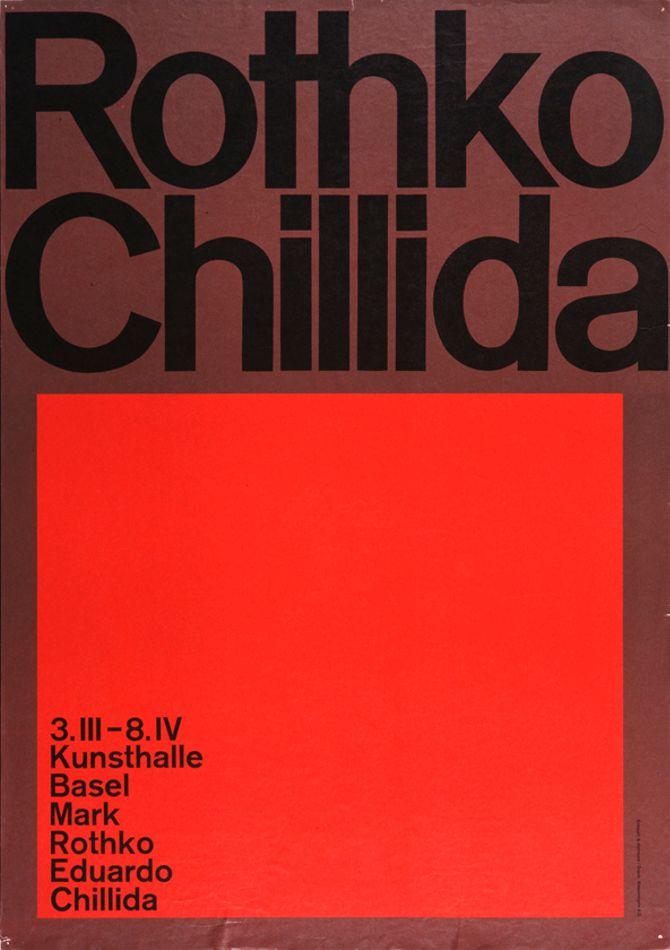
Hofmann, Armin. Kunsthalle Basel – Rothko Chillida. 1962. Public domain through Wikicommons.
Search
Contact
Proudly powered by WordPress